
You know you need support, but you’re not sure what kind.
Maybe you want help managing anxiety but don’t know whether that means starting therapy or considering medication. Perhaps you have already spent months talking through depression and still feel physically exhausted, unmotivated, or unable to concentrate. Or you may suspect ADHD and wonder whether a therapist can diagnose it or prescribe treatment.
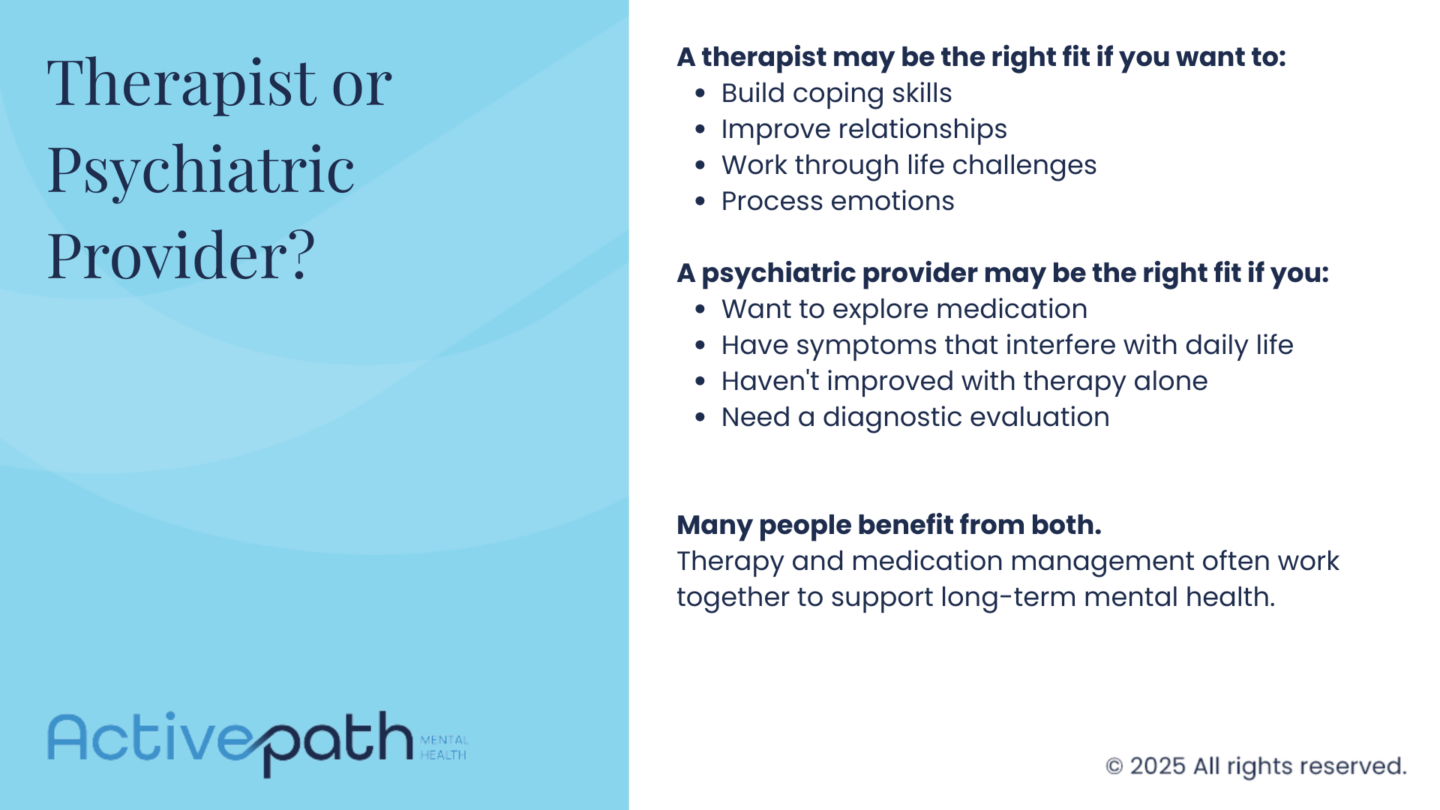
Therapists and psychiatric providers support different aspects of mental health care, and many people benefit from working with both.
Therapists focus primarily on thoughts, emotions, behaviors, relationships, and coping patterns. Psychiatric providers assess symptoms from a medical perspective and may prescribe medication when it’s appropriate. Understanding those roles can make it easier to choose where to begin.
Whether you’re beginning your mental health journey or looking for additional support,our team is here to help you move forward with confidence.
What Is the Difference Between a Therapist and a Psychiatric Provider?
The clearest difference is the type of treatment each provider offers.
A therapist uses psychotherapy to help you examine patterns, process experiences, and develop skills. Alternatively, a psychiatric provider evaluates mental health symptoms alongside medical history and can prescribe medication.
Neither role exists in isolation. A therapist may notice that symptoms appear severe enough to warrant a medication evaluation. A psychiatric provider may recommend therapy because medication alone will not address trauma, relationship patterns, avoidance, or self-criticism.
What a Therapist Helps You Work Through
Therapy creates space to examine what is happening beneath the surface of a problem.
You might work with a therapist to understand:
- Why conflict triggers such a strong response
- How anxiety influences avoidance
- Why certain negative thoughts keep returning
- How past experiences affect current relationships
- Which coping habits help and which ones make things harder
Depending on their training, therapists may use cognitive behavioral therapy, acceptance and commitment therapy, dialectical behavior therapy, interpersonal therapy, or trauma-informed approaches.
Therapy is a structured process that helps you recognize patterns, develop new coping skills, and respond to challenges in healthier ways.
What a Psychiatric Provider Evaluates
A psychiatric provider looks at mental health through both a psychological and medical lens.
That may include reviewing:
- Mood and anxiety symptoms
- Sleep, appetite, and energy
- Attention and concentration
- Previous medication use
- Family psychiatric history
- Physical health conditions
- Other prescriptions or supplements
- Alcohol or substance use
- Possible medication interactions
Psychiatric care may be provided by a psychiatrist, psychiatric mental health nurse practitioner, or another qualified medical professional.
A psychiatric evaluation helps determine whether medication may be beneficial, whether another condition should be considered, and which treatment approach is most appropriate.
Which Provider Should I Start With?
There is no universal answer, but the nature of your concern can point you in the right direction.
Therapy May Be the Better Starting Point When:
- You are dealing with grief, stress, or a major life transition
- Relationship problems are the primary concern
- You want help changing thought or behavior patterns
- Trauma or past experiences are affecting the present
- You need stronger coping or communication skills
- Symptoms are manageable but continue to interfere with your quality of life
A therapist can also help determine whether a psychiatric consultation would add value later.
A Psychiatric Evaluation May Be the Better Starting Point When:
- Symptoms feel intense, persistent, or physically overwhelming
- You suspect ADHD, bipolar disorder, or another condition requiring medical assessment
- Sleep, appetite, energy, or concentration have changed significantly
- You have already tried therapy without enough improvement
- You have taken psychiatric medication before
- You want to discuss whether medication could help
- Several mental or physical health issues may be interacting
You don’t need to diagnose yourself before scheduling care. A mental health clinic can help direct you to the most appropriate provider.
What Signs Suggest Medication Management May Be Helpful?
Medication management may be worth considering when symptoms remain disruptive even though you are using coping tools or attending therapy.
For example, you may understand why you feel anxious but still experience panic, racing thoughts, or intense physical tension. You may know how depression affects your thinking, but remain unable to feel motivated or rested. You may have strong organizational strategies for ADHD but still struggle to sustain attention long enough to use them consistently.
Medication may help reduce the intensity of these symptoms so other forms of treatment become easier to use.
You Have Insight but Still Feel Stuck
Therapy can create clarity without always resolving the biological symptoms of a condition.
Someone may understand their negative thought patterns but still feel persistently low. Another person may recognize anxiety triggers but continue experiencing severe physical symptoms.
That does not mean therapy has failed. It may mean another layer of support is needed.
Symptoms Keep Returning
Mental health symptoms sometimes improve briefly and then return.
Recurring periods of depression, panic, irritability, or impaired concentration may warrant a psychiatric evaluation, especially when they follow a recognizable pattern or become more difficult to manage over time.
Side Effects or Previous Medication Problems Need a Closer Look
A prior medication experience may have been disappointing, but that does not necessarily mean all medication will be ineffective.
A psychiatric provider can review:
- Whether the medication matched the diagnosis
- Whether the dose was high enough
- Whether it was taken long enough
- Which side effects occurred
- Whether another medication may have affected the outcome
- Whether the original diagnosis still fits
This review is especially important before assuming you have treatment-resistant depression or another difficult-to-treat condition.
Your Symptoms Interfere With Therapy Participation
Some symptoms make it hard to benefit fully from therapy.
Severe depression can make it difficult to complete exercises between appointments. Anxiety can make concentration difficult. ADHD can interfere with remembering skills or following through on plans.
Medication does not do the work of therapy, but it may help create enough stability for that work to become more productive.
What Happens During a Psychiatric Evaluation?
A psychiatric evaluation is a detailed conversation, not a test you can pass or fail.
Your provider will try to understand the full pattern of your symptoms rather than focusing on one difficult day.
Topics may include:
- When symptoms began
- Whether they are constant or episodic
- How sleep and energy have changed
- Changes in appetite or weight
- Work, school, or relationship concerns
- Previous therapy and medication
- Medical conditions
- Family history
- Substance use
- Current safety concerns
You may also complete questionnaires that help measure depression, anxiety, ADHD symptoms, or mood changes.
The evaluation may lead to a diagnosis, but sometimes more information is needed. Your provider may request medical records, recommend laboratory testing, or schedule a follow-up assessment before suggesting treatment.
Will I Be Prescribed Medication Right Away?
Not necessarily.
A provider may prescribe medication during the first appointment when the diagnosis and treatment needs are clear. In other cases, it may be safer to gather more information first.
Before starting medication, your provider should explain:
- What the medication is intended to treat
- Common side effects
- Important risks
- Possible interactions
- How long it may take to work
- What changes to watch for
- When to return for follow-up
Medication decisions should be collaborative. You should feel comfortable asking why a medication is being suggested and what alternatives are available.
What Does Medication Management Involve After the First Appointment?
Medication management continues after the prescription is written.
Follow-up visits allow your provider to assess whether the treatment is helping and whether the plan needs to change.
Those appointments may cover:
- Symptom improvement
- Side effects
- Sleep and appetite
- Mood changes
- Medication consistency
- New health concerns
- Dose adjustments
- Whether treatment goals are being met
Some medications work gradually, so early follow-up may focus on tolerability rather than full symptom relief. Other medications require closer monitoring or gradual dose changes.
The process should feel responsive rather than rigid. If a medication isn’t helping, your provider can reassess instead of leaving you on the same plan indefinitely.
Can Therapy and Medication Management Be Used Together?
Yes. In many cases, they are most effective when used together because they address different parts of the same problem.
Medication may reduce symptoms such as persistent low mood, panic, impaired attention, or mood instability. Therapy helps you build the insight and skills needed to respond differently to stress, relationships, and emotional triggers.
For example:
- Medication may improve energy while therapy helps rebuild routines.
- Medication may reduce panic symptoms while therapy addresses avoidance.
- ADHD medication may improve focus while therapy supports organization and self-esteem.
- Mood stabilization may make it easier to process difficult experiences safely.
Coordinated care can also prevent conflicting recommendations. With your permission, your therapist and psychiatric provider may share relevant updates and align treatment goals.
What if Therapy and Medication Still Are Not Enough?
Some people continue experiencing significant depression despite appropriate therapy and medication. That may be a sign to reassess the diagnosis, review previous treatment more carefully, or consider a different type of care.
At Active Path, qualifying patients may explore options such as:
TMS Therapy
Transcranial Magnetic Stimulation uses targeted magnetic pulses to stimulate brain regions involved in mood regulation. It may be considered when depression has not responded adequately to antidepressants.
TMS is noninvasive, does not require anesthesia, and is completed through a series of outpatient sessions.
SPRAVATO®
SPRAVATO is an esketamine nasal spray approved for adults with treatment-resistant depression and certain adults with major depressive disorder accompanied by acute suicidal ideation or behavior.
It’s administered in a certified medical setting, and patients remain for monitoring after each dose.
These treatments are not automatic next steps for everyone. A provider must review your diagnosis, medication history, symptoms, and medical background before determining whether either may be appropriate.
How Active Path Coordinates Mental Health Care
Mental health treatment often becomes fragmented. One provider handles therapy, another prescribes medication, and the patient is left trying to connect the pieces.
Active Path offers several services within the same care system, including:
- Individual therapy
- Psychiatric evaluations
- Medication management
- ADHD care
- Depression and anxiety treatment
- TMS
- SPRAVATO®
This makes it easier to adjust care when your needs change. You may begin with therapy and later add medication management, or start with a psychiatric evaluation and receive a therapy referral as part of the plan.
Our approach is to recommend the combination of services that best aligns with your symptoms, goals, and treatment history
Choosing Where to Begin
You don’t need to know exactly which provider you need before reaching out.
Start with what you know: what has changed, how long it has been happening, and what feels hardest to manage. A therapist or psychiatric provider can help clarify the rest.
Therapy may help you understand and change emotional or behavioral patterns. Psychiatric care may help determine whether medication can reduce symptoms that feel difficult to manage on your own. Sometimes one is enough. Often, the two work best together.
Contact Active Path Mental Health to find the right starting point for therapy, psychiatric evaluation, or medication management across Oregon and Washington.