
Trying to understand your insurance before starting mental health care can feel like a task in itself. You may know you have coverage, but that doesn’t always tell you what therapy, medication management, TMS, or another service will actually cost.
The good news is that you don’t have to become an insurance expert before making an appointment. A few basic questions can help you verify your mental health insurance, understand what your plan may cover, and avoid some of the billing surprises that can come with starting treatment.
It’s also worth checking benefits before your first visit rather than assuming that every mental health provider, service, or location is covered in the same way. Your deductible, copay, coinsurance, network status, and authorization requirements can all affect what you pay.
At Active Path, the intake team can help complete a verification of benefits with your insurance provider after your initial consultation, giving you a clearer picture of coverage before treatment begins. Reach out to us today.
What Information Should I Have Ready?
Before you call your insurance company or speak with a provider’s billing team, gather a few basic pieces of information.
You’ll usually want to have:
- Your insurance card
- Member or subscriber ID
- Group number, if applicable
- Name and date of birth of the policyholder
- Your relationship to the subscriber if the plan belongs to someone else
- The name of the provider or practice you’re considering
- The type of mental health service you’re interested in
- Any referral or authorization information you’ve already received
Your insurance card is usually the easiest place to start. Many plans include a member services number, and some list a separate behavioral health phone number for questions about mental health benefits.
Having accurate insurance details matters because even a small mismatch in patient information can create delays when a provider tries to verify eligibility or submit claims later.
If you recently changed jobs, switched plans, or received a new card, make sure you’re using the most current information.
What Does Insurance Verification Actually Tell Me?
Insurance verification is the process of confirming that your health plan is active and checking how it applies to the service you’re seeking.
A benefits verification may include questions about:
- Whether your coverage is currently active
- Whether a provider is in network
- Your deductible and how much you’ve already met
- Copay or coinsurance amounts
- Whether prior authorization is required
- Any limits on specific services
- Whether referrals are necessary
- Coverage for telehealth
- Your estimated out-of-pocket responsibility
Coverage details vary even between people who use the same insurance company. One plan may cover outpatient therapy with a flat copay, while another requires the patient to meet a deductible before the insurer starts sharing the cost.
Knowing the name of your insurance company alone isn’t enough. Your individual policy determines how your benefits apply.
What Questions Should I Ask My Insurance Company?
If you decide to call member services yourself, be as specific as possible.
Rather than simply asking, “Do I have mental health coverage?” you can ask questions such as:
- Is this provider currently in network with my plan?
- Are outpatient mental health services covered?
- Do I need to meet a deductible before benefits begin?
- What is my copay or coinsurance for each visit?
- Is there a separate behavioral health deductible?
- Do I need a referral from my primary care provider?
- Is prior authorization required?
- Are telehealth appointments covered?
- Are there limits on the number of mental health visits?
- Does my plan cover the specific treatment I’m considering?
- What would my benefits look like with an out-of-network provider?
If you’re checking coverage for a specialized treatment such as TMS or SPRAVATO®, ask about that service directly rather than assuming it falls under the same benefits as talk therapy.
It can also help to write down the date of your call, the representative’s name, and any reference number you’re given. Insurance details can be complicated, and having a record of the conversation gives you something to refer back to later.
What Do Deductible, Copay, and Coinsurance Mean?
- A deductible is the amount you generally pay for covered services before your insurance plan begins sharing more of the cost. If you haven’t met your deductible yet, your responsibility for early appointments may be higher.
- A copay is a fixed amount you pay for a covered service. For example, your plan might require a set fee for each outpatient mental health visit.
- Coinsurance works differently. Instead of a fixed amount, you pay a percentage of the covered cost after any applicable deductible has been met.
Your costs will depend on the service, provider, and network. HealthCare.gov explains that Marketplace plans can include deductibles, copayments, coinsurance, and other out-of-pocket costs even though mental health services qualify as essential health benefits.
Knowing how your plan handles deductibles, copays, and coinsurance gives you a clearer idea of what to expect financially before treatment starts.
Why Does In-Network Status Matter?
An in-network provider has an agreement with your insurance company to provide covered services at negotiated rates. Seeing someone in-network often results in lower out-of-pocket costs, although the exact amount still depends on your plan.
Out-of-network care can work differently. Your insurer may cover a smaller portion of the service, require a separate deductible, or provide no benefits at all for certain providers. Before scheduling, it’s best to confirm network status with both your insurance company and the practice whenever possible.
Provider directories are useful starting points, but they aren’t always updated immediately. A practice can usually tell you which plans it participates with, while your insurer can confirm how that relationship applies to your specific policy.
Active Path is currently in-network with most major commercial plans, as well as Medicare, Medicaid through Oregon Health Plan/CareOregon, TRICARE, and TriWest. Coverage varies by service, so benefits still need to be verified for the treatment you’re considering.
Does Insurance Have to Cover Mental Health Care?
Many health plans include important protections for behavioral health coverage, although the exact benefits still depend on the policy. Marketplace health insurance plans must cover mental health and substance use disorder services as essential health benefits. Covered care includes services such as psychotherapy, counseling, inpatient behavioral health treatment, and substance use disorder care.
Federal parity protections also generally prevent applicable plans from placing stricter financial or treatment limits on mental health and substance use benefits than they place on comparable medical and surgical care. Parity protections can apply to deductibles, copays, visit limits, and prior authorization requirements.
Your specific benefits still depend on several factors. Network status, medical necessity requirements, prior authorization, and cost-sharing all influence what your plan pays for. Reviewing your policy details gives you the clearest picture of what your insurance will cover.
What Is Prior Authorization?
Some mental health services require prior authorization, which means your insurance company must review and approve the treatment before coverage begins. This can be especially relevant for specialized or ongoing treatment.
The authorization process may require your provider to submit clinical information showing that a service meets the insurance plan’s medical necessity criteria. The exact requirements depend on the treatment and insurer.
Prior authorization doesn’t mean the service isn’t covered. It just means your insurance company needs to review and approve it before treatment starts or continues. If authorization is required, ask whether your provider handles the request or whether there’s anything you need to do yourself.
Can My Insurance Limit Mental Health Visits?
Some insurance plans place limits or conditions on certain services, although federal parity protections affect how insurers structure those restrictions. Ask your insurer whether your plan includes visit limits, authorization requirements, or periodic reviews for ongoing treatment. Outpatient therapy benefits may work differently from coverage for TMS, medication management, inpatient psychiatric care, or telehealth appointments.
Your Summary of Benefits and Coverage gives you a useful starting point, but the document may not answer every question about a specific service. Calling the insurance company directly helps fill in the missing details.
Why Can Coverage Change Even If I Already Verified It?
Insurance verification gives you the best information available at that point in time, but it isn’t always a guarantee of payment.
Coverage can change if your policy becomes inactive, you switch plans, your employer changes benefits, authorization expires, or the insurer determines that a service doesn’t meet its coverage criteria.
Your deductible balance can also change throughout the year as other claims are processed. That’s why providers may perform eligibility checks again during ongoing treatment, especially at the beginning of a new calendar year or after an insurance change.
If you receive a new card or learn that your coverage has changed, let your provider know as soon as possible. Updating patient information early can help prevent unnecessary delays or denied claims later.
How Can Active Path Help Verify Benefits?
You don’t necessarily have to handle the verification process by yourself.
Active Path offers a free phone consultation with its intake team. During that conversation, our team learns more about your needs and discusses whether treatments such as TMS, SPRAVATO®, therapy, or medication management may be appropriate. Afterward, we complete a verification of benefits with your insurance provider. The goal is to confirm coverage and give you more information about your options before you start treatment.
That can be especially helpful if you’re trying to understand whether a specialized service requires prior authorization or how your behavioral health benefits apply.
You can still contact your insurer directly if you want additional confirmation. Checking with both the practice and your insurance company can give you a fuller picture of your coverage before care begins.
What Should I Do If My Insurance Doesn’t Cover a Service?
Finding out that a particular treatment isn’t covered can be frustrating, but it doesn’t always mean you’re out of options.
Start by asking why coverage was denied or excluded. The answer may be related to network status, authorization requirements, medical necessity criteria, missing information, or the specific terms of your plan.
Depending on the situation, you may be able to appeal a decision, submit additional documentation, explore another covered treatment, or discuss payment options with the practice. The important thing is to understand the reason before assuming there’s no path forward.
A Little Insurance Homework Can Prevent Bigger Surprises
Mental health insurance can feel complicated, especially when you’re already trying to figure out what type of care you need. Rest assured, you don’t have to understand every billing code or insurance rule before reaching out for help.
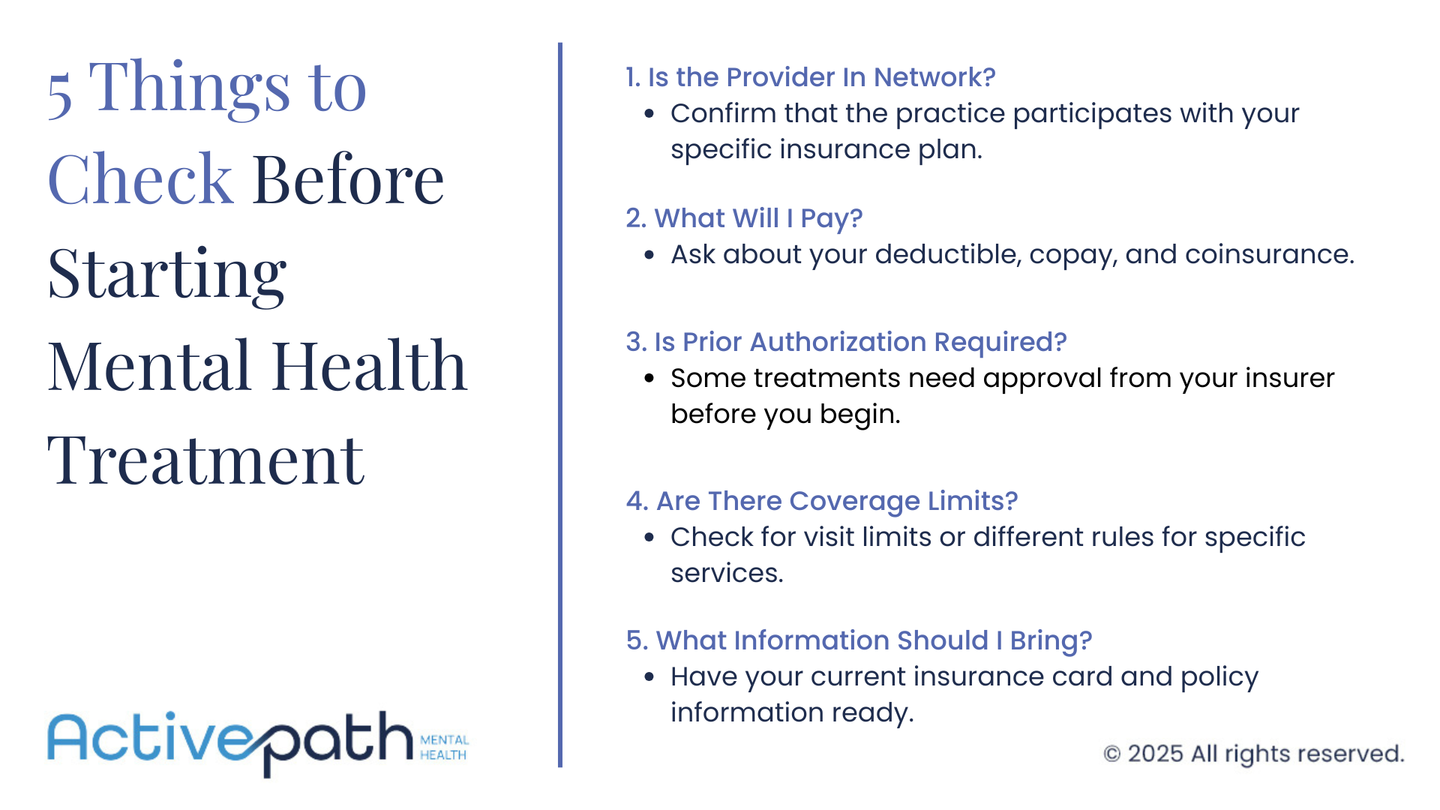
Start with the basics: confirm that your plan is active, ask whether the provider is in-network, understand your deductible and cost-sharing, and find out whether authorization is required.
From there, the provider’s intake or billing team can often help with the more detailed verification process.
At Active Path, benefits are verified before treatment begins so patients can better understand their coverage and expected costs.
If you’re considering TMS, SPRAVATO®, medication management, or therapy, contact Active Path to schedule a free consultation and learn how your insurance benefits may apply.