
If you’re exploring SPRAVATO insurance coverage, one of the first questions you may have is whether your insurance will help pay for treatment. For many eligible patients, the answer may be yes. Most major insurance plans cover SPRAVATO under specific conditions, but coverage varies by insurance provider, plan structure, diagnosis, treatment history, and medical necessity.
SPRAVATO is an FDA-approved esketamine nasal spray for adults with treatment-resistant depression (TRD), either as monotherapy or in conjunction with an oral antidepressant. It is also approved for depressive symptoms in adults with major depressive disorder (MDD) with acute suicidal ideation or behavior when used with an oral antidepressant. SPRAVATO must be administered under the supervision of a healthcare provider, and patients must be monitored for at least two hours after each treatment session because of safety requirements under the SPRAVATO REMS program.
At Active Path Mental Health, we know that advanced mental health treatment can feel overwhelming, especially when insurance questions are involved. Our team helps patients understand their insurance benefits, gather documentation, and navigate the prior authorization process before they begin treatment.
Reach out today to learn how Active Path can help you understand costs, insurance coverage, and eligibility for SPRAVATO treatment.
Do Insurance Providers Like UHC, Optum, Moda, or Providence Cover SPRAVATO?
Many major insurance carriers, including UnitedHealthcare, Optum, Moda, Providence, Aetna, Cigna, Blue Cross Blue Shield, Medicare, and some Medicaid programs may provide coverage for SPRAVATO when patients meet specific criteria. However, insurance coverage for SPRAVATO is not automatic.
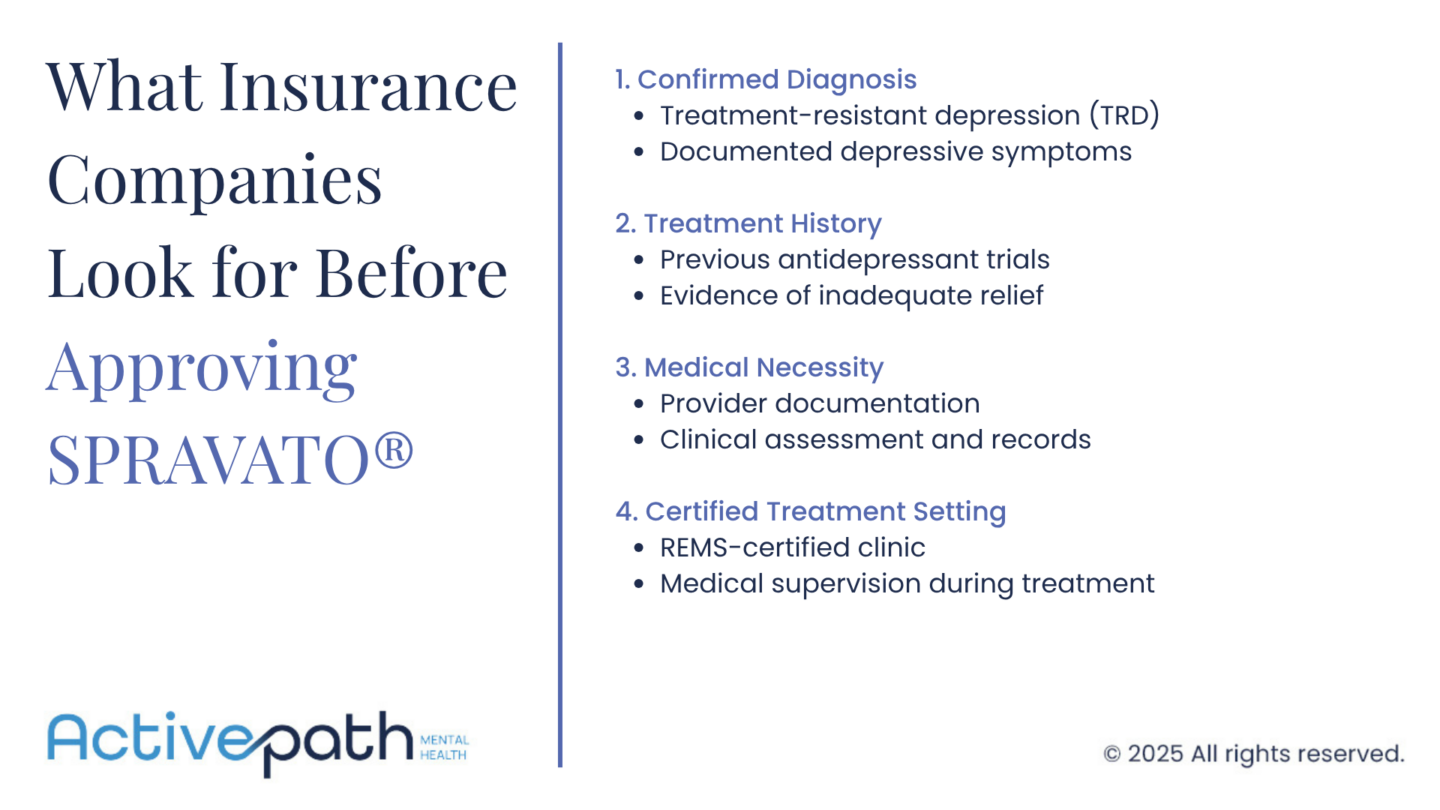
Most insurers evaluate whether SPRAVATO treatment is medically necessary. For eligible patients, this usually means a qualified healthcare provider has confirmed a formal diagnosis of treatment-resistant depression and documented that other treatments have not provided adequate relief.
Insurance companies may look for:
- A confirmed diagnosis of TRD
- Medical records showing trials of at least two antidepressant medications
- Adequate doses and treatment duration for previous medications
- Initial depression scores from standardized rating scales
- Documentation of current depressive symptoms
- A treatment plan from a qualified healthcare provider
- Confirmation that treatment will occur in a certified medical setting
If you are searching for UHC SPRAVATO coverage, it is important to check your specific plan. Some UnitedHealthcare members may have behavioral health benefits managed through Optum, so your insurance card may list both UHC and Optum. In that case, Optum may help manage the authorization process or behavioral health network.
It is also important to understand the difference between SPRAVATO and ketamine therapy. Many patients ask, “Is ketamine therapy covered?” SPRAVATO is related to ketamine, but it is not the same as IV ketamine or compounded ketamine. SPRAVATO is FDA-approved for specific conditions and administered in certified treatment centers. IV ketamine for depression is often considered an off-label treatment, so coverage is usually less consistent.
What Is Prior Authorization and Why Is It Required?
Prior authorization is the process your insurance company uses to decide whether it will approve coverage before treatment begins. Most insurance plans require prior authorization for SPRAVATO because it is a specialized treatment with specific FDA-approved uses, safety requirements, and eligibility criteria.
During this process, your healthcare provider must submit detailed documentation to your insurance company. This may include:
- Diagnosis and medical history
- Treatment history with traditional antidepressants
- Records showing previous treatment failures
- Depression rating scale results
- Current symptom severity
- Documentation of medical necessity
- A proposed SPRAVATO treatment plan
- Confirmation that treatment will occur under medical supervision
Patients typically need to document trials of at least two antidepressants before coverage is approved. Some insurance plans may require proof of trying two to four different antidepressant medications, depending on the specific plan.
The prior authorization process often takes one to three weeks, though timing can vary. Initial documentation quality matters. Clear medical records, confirmed diagnosis, and detailed treatment history can increase the chances of approval.
If insurance denies coverage, it does not always mean the process is over. Denials may happen because of insufficient documentation, missing medical records, or questions about medical necessity. In some cases, an appeal with stronger documentation may help reverse the decision.
At Active Path, insurance coordinators help patients navigate prior authorization, submit insurance information, answer insurance questions, and communicate with the insurance company whenever possible.
What Costs Should Patients Expect if Coverage Is Approved?
Even when insurance approves SPRAVATO, patients may still have out-of-pocket costs. The actual cost depends on your specific plan, deductible, copay, coinsurance, whether Active Path is in network, and whether the medication is billed under the medical or pharmacy benefit.
Without insurance, SPRAVATO can be expensive. Published estimates often place SPRAVATO costs in the thousands per month, especially during the initial treatment phase when sessions are more frequent.
If coverage is approved, patients may pay much less. Depending on the plan, copays may range from low or no cost to a higher per-session amount. Some patients may pay $0 to $400 out of pocket during initial treatment, while others may pay more if they have a high deductible, coinsurance, or out-of-network benefits.
Common costs may include:
- Copay: A fixed amount paid per session
- Deductible: The amount you pay before insurance begins covering certain services
- Coinsurance: A percentage of the cost you pay after meeting your deductible
- Medication cost: What your plan charges for the SPRAVATO medication itself
- Monitoring or visit cost: Charges related to provider supervision and at least two hours of post-dose observation
- Out-of-network fees: Higher costs if you see an out-of-network provider
Medicare coverage may apply differently than commercial insurance. In some cases, Medicare Part D may cover the medication while Medicare Part B covers clinical monitoring when SPRAVATO is administered in a doctor’s office or qualifying medical setting. Medicare and Medicaid may use specific billing codes for coverage, and Medicaid coverage varies by state.
Some eligible patients may also qualify for savings programs, patient assistance programs, flexible payment plans, or other cost-support options. SPRAVATO offers patient assistance programs for some patients, though eligibility depends on insurance status and program rules.
Why SPRAVATO Coverage Is More Complex Than Standard Therapy Coverage
SPRAVATO coverage can be more complex than standard therapy or medication management because the treatment includes both a medication and a supervised in-office treatment session.
Unlike a traditional oral antidepressant picked up at a pharmacy, SPRAVATO must be given in a certified treatment center under direct medical supervision. Each session includes nasal spray administration, monitoring for safety, and assessment before the patient can leave.
Because of this, your insurance company may evaluate several parts of the care process separately, including:
- Whether the medication is covered
- Whether the clinic is in network
- Whether monitoring is covered
- Whether prior authorization is required
- Whether ongoing treatment remains medically necessary
That is why it is important to ask your insurance provider detailed questions before starting treatment.
Questions to Ask Your Insurance Provider
Before you start treatment, call the number on your insurance card and ask:
- Does my insurance cover SPRAVATO?
- Is SPRAVATO covered under my medical benefit or pharmacy benefit?
- Does SPRAVATO require prior authorization?
- What documentation is needed for approval?
- Is Active Path Mental Health in network?
- What will my copay or coinsurance be?
- Does my deductible apply?
- Are monitoring visits covered?
- Are there limits on the number of treatments?
- What happens if coverage is denied?
These questions can help you understand what to expect financially before treatment begins.
How Active Path Helps With SPRAVATO Insurance Coverage
At Active Path Mental Health, we work to make innovative treatments feel more accessible and less confusing. Our team helps patients understand the steps involved in insurance verification, prior authorization, and treatment planning.
We can help with:
- Reviewing insurance information
- Verifying benefits
- Gathering treatment history
- Supporting prior authorization submissions
- Explaining potential out-of-pocket expenses
- Coordinating approved treatment appointments
- Helping patients understand next steps if insurance denies coverage
While we cannot guarantee that your insurance company will approve or pay for SPRAVATO, we can help you understand what may be required and how to begin the process.
Considering SPRAVATO? Here’s What to Do Next
If you have tried multiple antidepressants without adequate relief, SPRAVATO may be a life-changing treatment option worth exploring. Most major insurance plans may cover SPRAVATO for eligible patients, but coverage details vary widely by commercial insurance plan, Medicare, Medicaid, and specific plan rules.
Active Path Mental Health can help you verify your insurance benefits, understand prior authorization requirements, and determine whether SPRAVATO may fit your treatment plan.
Contact Active Path today to learn more about SPRAVATO insurance coverage and take the next step toward care.