
Depression treatment doesn’t always work on the first try. Some people improve after beginning an antidepressant or talk therapy, while others continue experiencing low mood, fatigue, loss of interest, sleep disruption, or difficulty functioning despite following a treatment plan.
When depression remains persistent after multiple appropriate treatments, a clinician may begin evaluating for treatment-resistant depression. This doesn’t mean depression is untreatable or that you have run out of options, but that your care may need to be reassessed, adjusted, or expanded.
If medication or therapy is no longer providing enough relief, reach out to discuss options such as TMS or SPRAVATO®.
What Does “Treatment-Resistant Depression” Mean?
Treatment-resistant depression, or TRD, generally describes major depressive disorder that has not improved adequately after at least two appropriate antidepressant trials.
An adequate trial usually means the medication was:
- Appropriate for the diagnosis
- Taken at a therapeutic dose
- Used consistently
- Continued long enough to evaluate its effects
The exact definition can vary among clinicians, researchers, and insurance plans. However, two unsuccessful antidepressant trials are commonly used as the point at which a provider begins considering treatment resistance.
TRD may involve depression that never meaningfully improves, improves only partially, or returns despite treatment. Symptoms can range from mild but persistent to severe and disabling.
Common symptoms include:
- Persistent sadness or emotional numbness
- Loss of interest or pleasure
- Low energy and motivation
- Difficulty concentrating
- Changes in sleep or appetite
- Feelings of worthlessness or hopelessness
- Withdrawal from family, friends, or daily activities
Compared with depression that responds to initial care, TRD is often more chronic and may create a greater personal, occupational, and social burden.
Treatment Resistance Does Not Mean Treatment Is Impossible
The term “treatment-resistant” can sound discouraging, but it certainly doesn’t mean someone cannot recover. It simply just means the treatments attempted so far have not provided sufficient relief.
A provider may recommend changing medication, adding another medication, incorporating psychotherapy, or exploring a treatment that works through a different biological pathway.
How Do Clinicians Diagnose Treatment-Resistant Depression?
There is no single blood test or scan that confirms TRD. Diagnosis involves a detailed review of symptoms, medical history, previous treatment, medication use, and daily functioning.
A comprehensive evaluation may examine:
- Which antidepressants you have tried
- The dose and length of each trial
- Whether medications were taken consistently
- Side effects or reasons treatment stopped
- Which forms of psychotherapy you have tried
- Whether symptoms improved partially
- How depression affects work, relationships, sleep, and self-care
- Other medications or health conditions
- Substance use and safety concerns
Clinicians may also use standardized depression rating scales to track symptom severity and response over time.
Ruling Out Other Causes
Before determining that depression is treatment-resistant, a provider should consider whether something else could be interfering with recovery.
Possible factors include:
- An inaccurate or incomplete diagnosis
- Bipolar disorder presenting as depression
- Anxiety, trauma, ADHD, or substance use
- Thyroid problems or other medical issues
- Medication interactions
- Poor sleep
- Inconsistent medication use
- A dose that was too low
- A treatment trial that ended too soon
For example, someone with undiagnosed bipolar disorder may not respond well to antidepressant treatment alone. These situations require a different strategy but don’t necessarily represent true treatment resistance.
What Are Common Signs That Medication or Therapy Isn’t Working?
Treatment progress isn’t always immediate. Antidepressants may take several weeks to produce their full effect, and psychotherapy requires time and participation.
However, certain patterns suggest your plan deserves another look.
1. Your Symptoms Have Not Meaningfully Improved
You may still experience the same level of sadness, fatigue, hopelessness, or loss of interest after completing an appropriate course of treatment.
Partial improvement can still be useful, but if symptoms continue interfering substantially with daily life, another strategy may be needed.
2. Improvement Is Limited or Short-Lived
Some people initially feel better but quickly lose that progress. Others notice one symptom improves while the overall depression remains.
Your provider may adjust the current plan rather than immediately abandoning it.
3. Side Effects Make Treatment Unsustainable
A medication may reduce symptoms but cause side effects such as nausea, sleep problems, fatigue, weight changes, sexual side effects, or emotional blunting.
Tell your provider about side effects instead of stopping medication abruptly. A dose adjustment or a different medicine may offer a better balance.
4. Daily Functioning Continues to Decline
Signs of continued impairment may include:
- Missing work or struggling to meet expectations
- Withdrawing from family and friends
- Neglecting meals, hygiene, or household responsibilities
- Losing interest in meaningful activities
- Finding basic decisions or tasks overwhelming
These changes may indicate that current treatment is not providing adequate relief.
5. Therapy Feels Stalled
Therapy can be uncomfortable, especially when discussing painful experiences. Temporary distress does not necessarily mean therapy is failing.
Still, reassessment may help if:
- Your goals are unclear
- Sessions feel repetitive without progress
- You do not feel safe or understood
- The therapy method does not match your needs
- Symptoms remain unchanged over time
Patients sometimes need to try different psychotherapy approaches. Cognitive behavioral therapy is commonly used for depression, while others may benefit from interpersonal therapy, behavioral activation, or trauma-focused care.
6. Depression Continues Despite Multiple Treatments
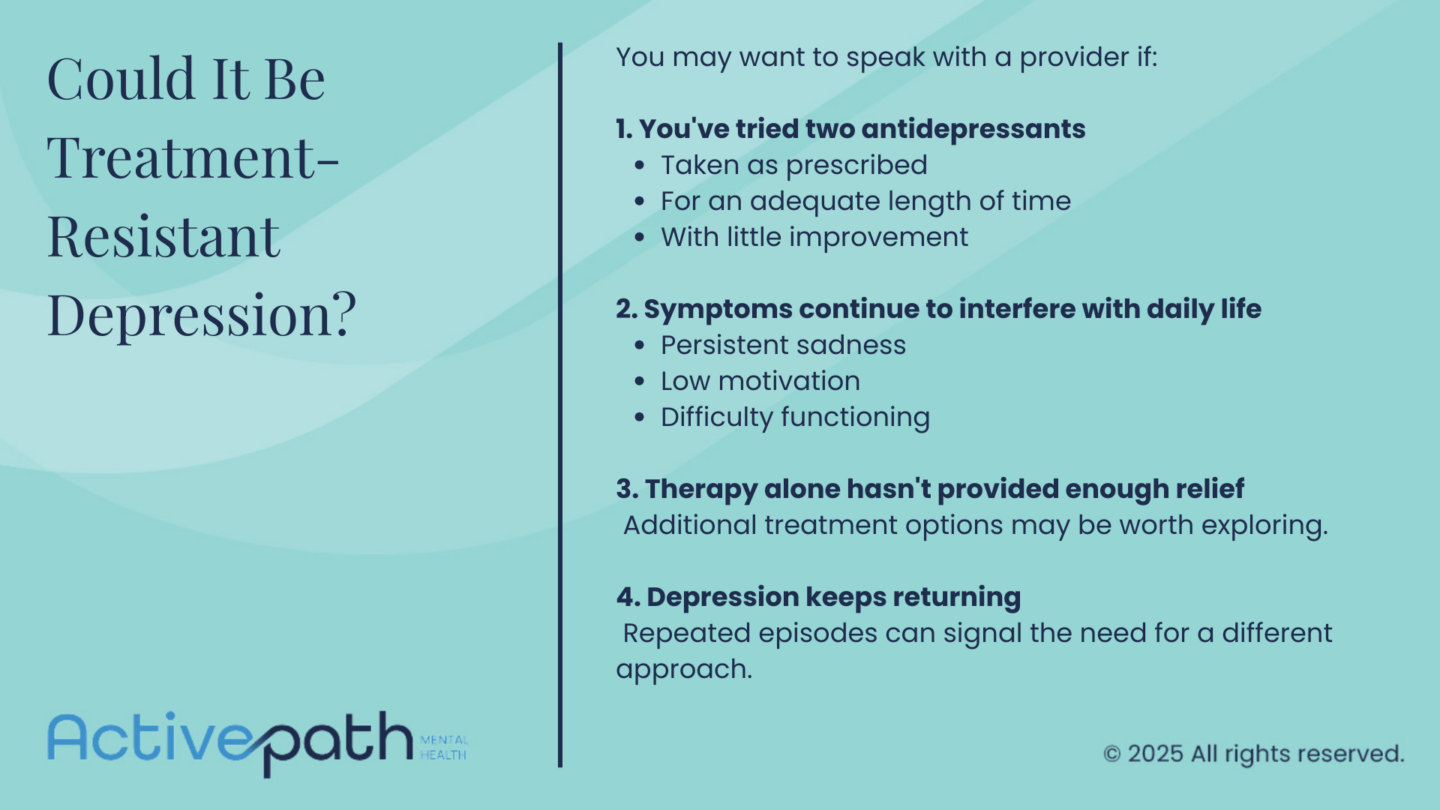
If you have completed at least two antidepressant trials without sufficient improvement, it may be time to ask whether you meet the criteria for treatment-resistant depression.
A qualified provider can review each treatment and determine whether further evaluation is appropriate.
What Alternative Treatment Options Should Patients Consider?
TRD treatment is individualized. Options may include adjusting medication, combining medication with psychotherapy, adding another medicine, or using a specialized treatment such as TMS or SPRAVATO.
Medication Adjustments
A provider may recommend:
- Changing the current dose
- Switching antidepressant classes
- Adding a second antidepressant
- Adding an augmentation medication
- Treating a co-occurring condition
- Addressing side effects that interfere with adherence
Augmentation means adding a medicine intended to improve the effect of an existing antidepressant. These decisions require medical supervision.
Psychotherapy
Medication and psychotherapy are often used together. Therapy can address negative thought patterns, avoidance, relationship difficulties, stress, and behaviors that may contribute to ongoing symptoms.
CBT may help patients:
- Challenge hopeless thoughts
- Develop coping and problem-solving skills
- Rebuild routines
- Increase participation in meaningful activities
If one form of therapy has not helped, a different therapist, format, or approach may be more appropriate.
Transcranial Magnetic Stimulation
Transcranial Magnetic Stimulation, or TMS, is a noninvasive treatment that uses magnetic pulses to stimulate brain regions involved in mood regulation.
TMS is commonly explored when antidepressants have not provided adequate relief or have caused difficult side effects. It doesn’t require anesthesia, and patients generally remain awake during treatment.
A standard course often involves several outpatient sessions each week over multiple weeks. Mild scalp discomfort or headache may occur, but most patients return to normal activities afterward.
SPRAVATO®
SPRAVATO is an esketamine nasal spray approved by the FDA for treatment-resistant depression in adults, either alone or with an oral antidepressant.
Unlike standard antidepressants, esketamine acts on the brain’s glutamate system. It is sometimes described as rapid-acting because improvement may occur sooner than with traditional antidepressants for some patients.
SPRAVATO is administered under direct healthcare provider supervision. Patients must be monitored in a certified treatment setting for at least two hours after each dose because of risks such as sedation, dissociation, increased blood pressure, and respiratory depression.
SPRAVATO is not the same as IV ketamine treatment. Its approved uses and safety requirements are specific to the branded esketamine nasal spray.
Electroconvulsive Therapy
Electroconvulsive therapy, or ECT, is a well-established treatment for severe depression, particularly when symptoms are life-threatening, psychotic, or have not responded to other interventions.
ECT is performed under anesthesia and may provide significant symptom relief, but it has different risks and preparation requirements than TMS.
Emerging and Investigational Treatments
Researchers continue studying:
- Personalized brain stimulation
- New medication combinations
- Psychedelic-assisted approaches
- Deep brain stimulation
- Treatments guided by biomarkers or brain imaging
Many of these remain investigational and may only be available through clinical trials. Patients should ask about FDA status, clinical evidence, provider credentials, and safety monitoring.
How Do Sleep, Exercise, and Other Lifestyle Factors Fit In?
Lifestyle changes cannot replace clinical treatment for significant depression, but they can influence symptoms and recovery.
Helpful strategies may include:
- Consistent sleep and wake times
- Regular physical activity
- Balanced nutrition
- Reduced alcohol or substance use
- Social connection
- Stress management
- Structured daily routines
The goal is not to suggest someone can exercise their way out of TRD. These habits are supportive parts of a comprehensive treatment plan.
How Active Path Evaluates the Next Step
At Active Path Mental Health, the next step begins with understanding what has already been tried and why it may not have worked.
A provider may review:
- Your diagnosis and current symptoms
- Previous medications and doses
- Therapy history
- Side effects
- Sleep and lifestyle factors
- Co-occurring conditions
- Safety concerns
- Treatment preferences and goals
From there, care may include medication management, talk therapy, TMS, SPRAVATO, or coordination with another specialist.
Finding Your Depression Next Steps
If depression has not improved after multiple treatments, it’s completely understandable to feel discouraged. But an inadequate response to previous care doesn’t mean meaningful improvement is impossible.
Your diagnosis may need another look, your medication may need adjustment, a different form of therapy may be more useful, or a specialized treatment may be appropriate.
A comprehensive evaluation can help identify the most reasonable next steps and determine whether you may be experiencing treatment-resistant depression.
Contact Active Path Mental Health to review your treatment history and explore options such as medication management, psychotherapy, TMS, or SPRAVATO.