
If you’ve been looking into TMS for depression, chances are you’ve already spent a lot of time researching how it works, whether it could help, and what treatment actually looks like. Then comes the practical question: Will insurance cover it?
For many people, the answer may be yes. Major insurance plans such as UnitedHealthcare (UHC), Optum, Moda, and Providence may cover TMS for qualifying patients with major depressive disorder, especially when other depression treatments have not provided enough relief.
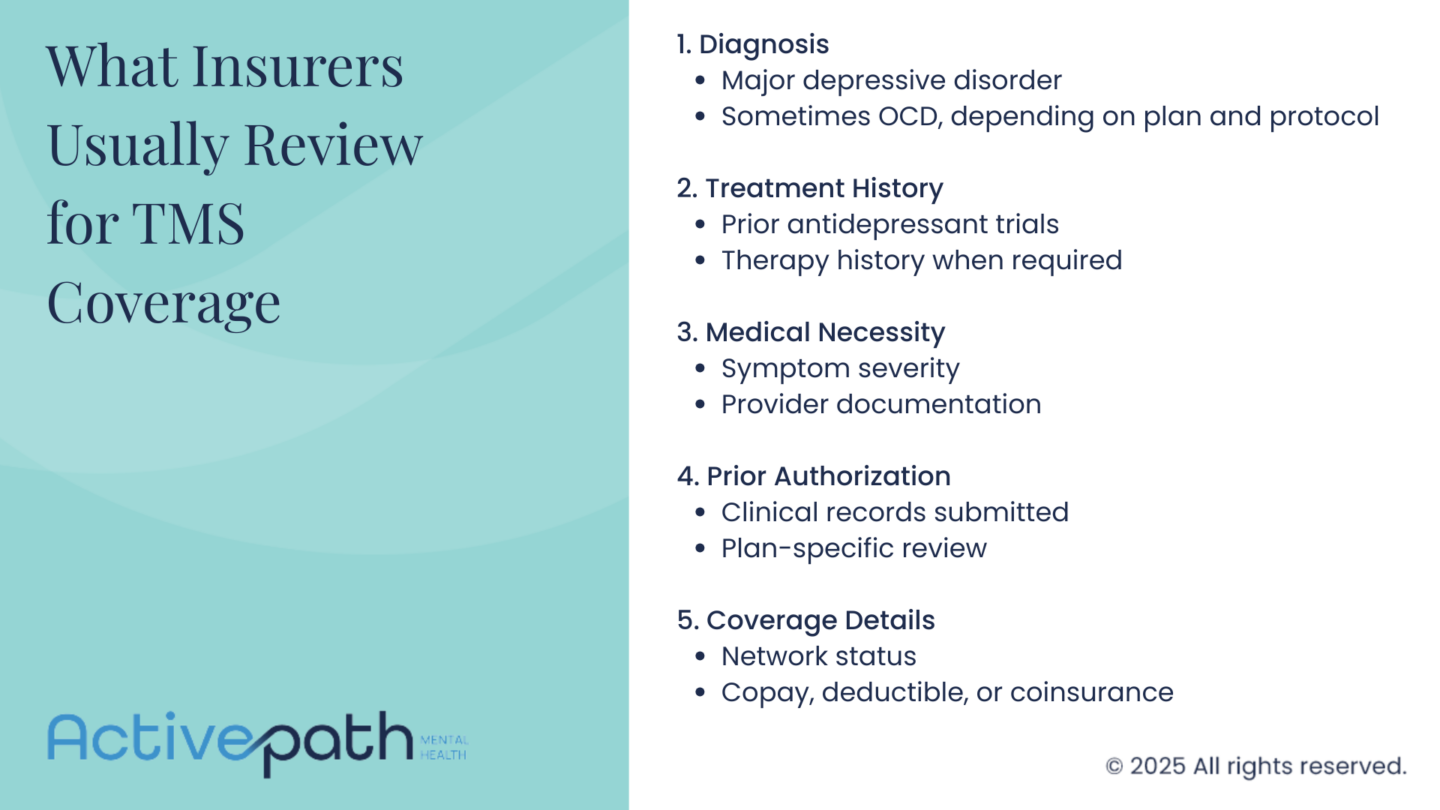
The catch is that coverage depends on your specific plan. Insurance companies may look at your diagnosis, medication history, previous therapy, symptom severity, and whether prior authorization is required before treatment begins.
At Active Path Mental Health, we help patients in Kirkland, Salem, and surrounding communities make sense of that process. Our team can verify benefits, review common eligibility requirements, and help gather the documentation insurers may request.
In this guide, we’ll walk through who may qualify for insurance-covered TMS, what paperwork is typically needed, what costs to expect, and what you can do if coverage is denied.
Wondering whether your plan may cover TMS? Contact Active Path to verify your benefits and learn what may be required before beginning treatment.
Who Qualifies for Insurance-Covered TMS?
Insurance companies generally evaluate TMS based on medical necessity. Most plans focus coverage on patients with a formal diagnosis of major depressive disorder, while some policies also cover certain FDA-cleared TMS treatments for obsessive-compulsive disorder.
TMS is a noninvasive therapy that uses magnetic pulses to stimulate nerve cells in brain regions involved in mood regulation. A typical depression treatment course lasts about four to six weeks, often with sessions several days each week.
Common insurance requirements may include:
- A documented diagnosis of major depressive disorder
- Evidence that previous antidepressant treatments did not provide enough relief
- Documentation of medication intolerance when applicable
- A history of psychotherapy for depression
- A baseline depression severity score
- Proof that TMS is medically necessary
Many insurers require patients to have tried multiple antidepressants before approving TMS, although the exact number varies. Some plans require two unsuccessful medication trials, while others may ask for additional treatment history.
Age requirements also vary by policy, so patients shouldn’t assume a universal age cutoff applies.
Does Insurance Cover Every Type of TMS?
Not necessarily. Coverage can depend on both the diagnosis and the specific TMS protocol being used.
Repetitive TMS
Traditional repetitive TMS (rTMS) has broad insurance acceptance for major depressive disorder, especially in treatment-resistant cases.
Deep TMS
Deep TMS has FDA clearance for major depressive disorder and obsessive-compulsive disorder. Insurance coverage is widely available for depression, while coverage for OCD continues to vary by insurer and plan.
Deep TMS for OCD received FDA marketing authorization in 2018, giving patients who had not responded adequately to standard treatments another noninvasive option.
Theta-Burst Stimulation
Intermittent theta-burst stimulation, or iTBS, is a shorter TMS protocol that delivers patterned magnetic stimulation. An FDA-cleared theta-burst TMS system received clearance in 2018.
Coverage for iTBS varies more than coverage for conventional rTMS. Some insurers include accelerated or theta-burst protocols within their TMS policies, while others apply additional restrictions or consider certain protocols investigational.
That is why the exact protocol should be verified with your insurer before treatment begins.
Accelerated TMS and SAINT™
Accelerated TMS protocols deliver several treatments within a shorter time period. One example is Stanford Accelerated Intelligent Neuromodulation Therapy, often referred to as SAINT™.
Coverage for accelerated TMS is evolving and varies considerably by payer and treatment setting. Patients interested in accelerated protocols should confirm coverage directly rather than assuming they fall under standard outpatient TMS benefits.
What Documentation Is Usually Required?
Documentation is one of the most important parts of obtaining TMS insurance coverage.
Insurers commonly request:
Diagnosis and Symptom Severity
Your provider may document:
- Major depressive disorder diagnosis
- Duration of the current depressive episode
- Impact on daily functioning
- Results from a validated depression rating scale
Medication History
Your records may need to show:
- Which antidepressants you tried
- The dose of each medication
- How long you took it
- Whether symptoms improved
- Any significant side effects
Most plans require evidence that prior antidepressant treatment did not provide satisfactory improvement.
Psychotherapy History
Some insurance policies also require documentation that psychotherapy was attempted or considered as part of the depression treatment plan.
Medical Necessity
Your provider submits documentation explaining why TMS is appropriate based on your diagnosis, treatment history, and current symptoms.
Safety Screening
Because TMS uses magnetic stimulation, your provider will review implanted devices, metal near the head, seizure history, and other factors that may affect treatment safety.
What Does TMS Therapy Cost With Insurance?
The TMS therapy cost varies widely depending on your insurance benefits, number of sessions, provider network, and treatment protocol.
When insurance covers treatment, the patient’s responsibility may include:
- Copays
- Deductible
- Coinsurance
- Mapping or initial treatment fees
- Out-of-network charges
Because a standard course may involve 30 or more sessions, even a modest per-visit copay can add up. For example, a $20 copay over 36 visits would total $720 before any additional covered services or deductible obligations. Your actual cost could be significantly higher or lower depending on your plan.
Before starting treatment, ask:
- Is TMS covered for my diagnosis?
- Is this specific TMS protocol covered?
- Is Active Path in network?
- What is my copay or coinsurance?
- Does my deductible apply?
- How many sessions are authorized?
- Are mapping and treatment billed separately?
What Happens if My Insurance Denies Coverage?
An insurance denial doesn’t always mean TMS is permanently unavailable.
Coverage may initially be denied because:
- Medication history is incomplete
- Psychotherapy records are missing
- Depression rating scores were not submitted
- Prior authorization was not completed
- Medical necessity was not sufficiently documented
- The requested protocol is outside the plan’s policy
- The provider is out of network
The first step is reviewing the denial letter carefully. Your provider may be able to submit additional documentation, correct missing information, or request reconsideration.
Some insurers also allow:
- Formal appeals
- Letters of medical necessity
- Peer-to-peer clinical reviews
- Additional records from previous providers
Approval after appeal is never guaranteed, but a denial may sometimes reflect incomplete documentation rather than a final determination that TMS is inappropriate.
Why the Type of TMS Matters for Coverage
“TMS” can refer to several different treatment protocols, and insurance policies don’t necessarily treat all of them the same way.
Traditional rTMS has the longest history of routine coverage for depression. Deep TMS is also broadly covered for depression and has growing coverage for OCD. Newer accelerated and theta-burst protocols may be handled differently depending on the payer.
Before committing to treatment, ask your provider exactly which TMS protocol is being recommended and whether your insurer recognizes it under your benefits.
How Active Path Helps With TMS Insurance Coverage
At Active Path Mental Health, our team can help make the insurance process more manageable by assisting with:
- Benefit verification
- Prior authorization
- Treatment-history documentation
- Medical-necessity records
- Cost estimates
- Insurer requests for additional information
- Appeal documentation when appropriate
Final coverage decisions remain with the insurance carrier, but careful preparation can reduce unnecessary delays.
Understanding Your Coverage and Treatment Options
If antidepressants and therapy have not provided enough relief, TMS may be worth discussing with a mental health provider. Many insurance plans cover standard TMS for qualifying patients with major depressive disorder, while coverage for other protocols can vary.
Understanding your diagnosis, prior treatment history, insurance benefits, and the exact TMS protocol being recommended can help you avoid surprises before treatment begins.
Contact Active Path Mental Health to verify your TMS benefits and learn whether this treatment may be appropriate for your depression.