
Obsessive-compulsive disorder (OCD) can be relentless. Intrusive thoughts. Repetitive behaviors. Mental rituals that feel impossible to stop. For many people, traditional treatment — including therapy and medication — is enough to manage symptoms. But for others, OCD remains persistent despite trying multiple approaches.
For individuals who have not responded to standard OCD therapies, advanced mental health treatment options like Transcranial Magnetic Stimulation (TMS) and SPRAVATO are available. These options provide new hope for those seeking effective care within a healthcare setting.
If you or a loved one is still struggling, you may be wondering: Is TMS better than SPRAVATO for OCD?
At Active Path, we offer both Transcranial Magnetic Stimulation (TMS) and SPRAVATO as part of advanced mental health care. But these treatments work differently — and they’re not interchangeable. This guide will help you understand how each option works, who may be a candidate, and what kind of results you can realistically expect.
If OCD is interfering with your daily life, Active Path can help you compare advanced treatment options like TMS and SPRAVATO®. Reach out today.
First, What Is the Standard Treatment for OCD?
Before comparing advanced treatments, it’s important to understand first-line care.
OCD is typically treated with:
- Exposure and Response Prevention (ERP) therapy
- High-dose SSRIs (Selective Serotonin Reuptake Inhibitors)
- Cognitive Behavioral Therapy (CBT)
- Traditional talk therapy, which is often combined with medications as an initial approach, though it may have limitations in cases of treatment-resistant OCD
For many patients, this combination is highly effective. However, about 40–60% of individuals with OCD experience an incomplete response to medication or therapy alone.
That’s where advanced interventions like TMS may come in.
What Is TMS and How Does It Treat OCD?
Transcranial Magnetic Stimulation Therapy (TMS) is an FDA-approved treatment and non-invasive procedure that uses magnetic fields to stimulate specific areas of the brain, particularly the prefrontal cortex, which is involved in mood regulation and compulsive behavior. This brain stimulation targets nerve cells to improve communication between neurons and promote neuroplasticity, helping to alleviate symptoms of depression and OCD. TMS is a drug-free option, making it suitable for patients seeking alternatives to medication.
For OCD specifically:
- The FDA has cleared a specific TMS protocol targeting the anterior cingulate cortex and related circuits.
- It is used when patients have not responded adequately to medication and therapy.
- Treatment is typically administered 5 days per week over 6–8 weeks.
How TMS Helps OCD
OCD is linked to overactivity in certain brain circuits. TMS helps regulate these circuits, reducing the intensity of intrusive thoughts and compulsive urges.
Patients often report:
- Reduced frequency of intrusive thoughts
- Lower anxiety around triggers
- Increased ability to resist compulsions
- Improved emotional regulation
TMS also helps improve communication between brain regions involved in OCD and mood regulation, supporting better overall brain function.
Importantly, TMS is non-invasive and does not require sedation or medication changes.
What Is SPRAVATO — and Is It Approved for OCD?
SPRAVATO (esketamine nasal spray) is FDA-approved for:
- Treatment-resistant depression (TRD)
- Major depressive disorder with acute suicidal ideation or behavior
SPRAVATO is specifically indicated for severe depression and severe symptoms, especially in cases where patients experience suicidal ideations or suicidal thoughts. Unlike traditional antidepressants, SPRAVATO targets glutamate receptors in the brain, providing rapid relief and quick relief of depressive symptoms. It is administered in a clinical setting and certified facilities under strict medical supervision, with patients monitored for a few hours after each dose due to potential side effects such as increased blood pressure.
It is not FDA-approved for OCD.
That distinction is important.
However, OCD frequently co-occurs with:
- Major depressive disorder
- Severe anxiety
- Treatment-resistant depression
In those cases, SPRAVATO may be used to treat the depressive component, which can indirectly improve OCD-related distress.
How SPRAVATO Works
Unlike SSRIs, SPRAVATO targets the glutamate system in the brain, promoting rapid neural connectivity changes. It is administered in a certified medical setting and monitored for two hours after each dose.
Patients may experience:
- Rapid improvement in depressive symptoms
- Reduced emotional intensity
- Greater cognitive flexibility
But again, it is not an FDA-cleared treatment for OCD itself.
TMS vs. SPRAVATO for OCD: Key Differences
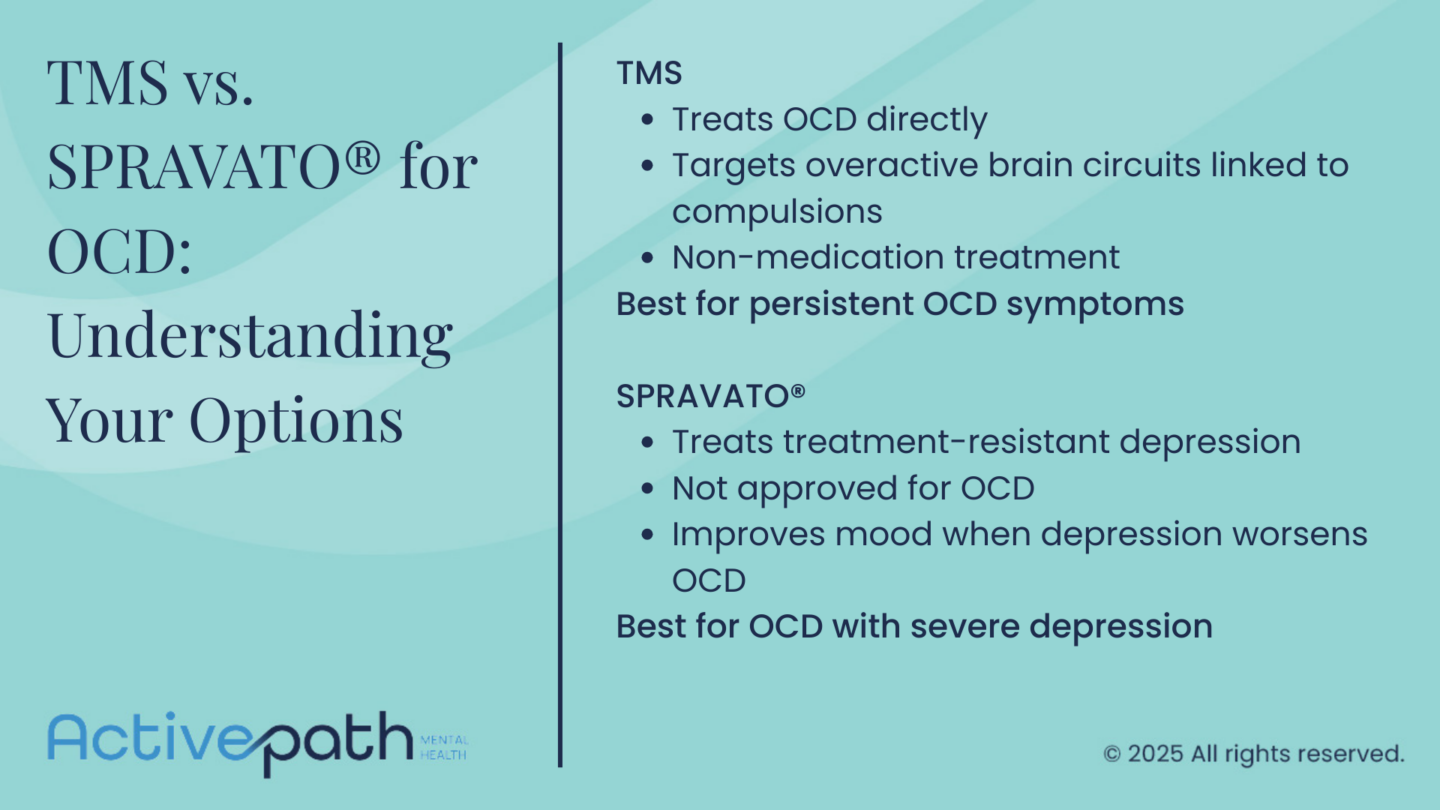
1. FDA Status
- TMS: FDA-cleared specifically for OCD
- SPRAVATO: Not approved for OCD (approved for depression only)
2. Target Symptoms
- TMS: Directly targets OCD brain circuits
- SPRAVATO: Targets depression symptoms and other mental health conditions that may coexist with OCD
3. Treatment Experience
- TMS: Daily in-office sessions; no sedation; no recovery time—patients can return to normal activities immediately after each session
- SPRAVATO: Twice-weekly initially; monitored nasal spray administration
4. Best Candidates
- TMS: Individuals with OCD not responding to ERP + medication
- SPRAVATO: Individuals with severe, treatment-resistant depression alongside OCD
It’s important to work with your healthcare provider to determine the right treatment for you, based on your individual symptoms and medical history.
Who Is a Good Candidate for TMS for OCD?
You may be a candidate for TMS if:
- You’ve tried ERP therapy consistently
- You’ve trialed at least one or two SSRIs
- OCD symptoms remain moderate to severe
- You want a non-medication option
- You are not currently experiencing uncontrolled seizures
TMS therapy is particularly appealing for patients who:
- Experience medication side effects
- Prefer non-systemic treatment
- Want to avoid additional medications
- Are seeking a non medication approach to mental health treatment
Some patients notice improvement after just a few sessions of TMS therapy. Additionally, patients can typically resume their normal activities immediately after each TMS session, making it a convenient option with minimal downtime.
When Might SPRAVATO Be Considered?
SPRAVATO may be appropriate if:
- You have OCD plus treatment-resistant depression
- Depression symptoms are severe and disabling
- Traditional antidepressants have failed
- Suicidal ideation is present alongside OCD
In these cases, treating the depression aggressively may help stabilize mood and increase your ability to engage in ERP therapy for OCD.
A personalized care approach and a comprehensive treatment plan are essential when considering SPRAVATO for co-occurring depression and OCD.
What Results Can Be Expected at Active Path?
With TMS for OCD:
TMS treatment is typically conducted over a period of four to six weeks, with patients often seeing gradual symptom improvement during this time. Research shows meaningful reduction in OCD severity scores in a significant percentage of patients who previously did not respond to medication alone.
With SPRAVATO (for co-occurring depression):
Patients may experience faster mood improvement, sometimes within days. SPRAVATO is administered at a specialized treatment site to ensure safety and proper monitoring, which can make it easier to participate in therapy and reduce hopelessness.
At Active Path, we do not treat diagnoses in isolation. We assess:
- Severity of OCD symptoms
- Presence of depression or suicidal ideation
- Treatment history
- Medical history
- Lifestyle considerations
Then we create a tailored recommendation.
Can TMS and SPRAVATO Be Used Together?
In certain complex cases involving both severe OCD and treatment-resistant depression, providers may consider sequential or coordinated use of treatments.
However:
- They target different mechanisms
- They require separate eligibility criteria
- They are not automatically combined
A thorough psychiatric evaluation is essential.
The Bottom Line: Which Is More Effective for OCD?
If we are speaking strictly about OCD itself:
TMS is the evidence-supported, FDA-cleared option.
SPRAVATO is not a direct OCD treatment, but it can be a powerful tool when depression is driving symptom severity or impairing therapy participation.
The “right” answer depends on your specific symptom profile.
Ultimately, the most effective approach is one that considers the whole person, addressing both mental and physical health needs for comprehensive care.
What’s the Next Step?
If OCD symptoms continue despite therapy and medication, it may be time to explore advanced treatment options.
At Active Path, our team provides:
- Comprehensive psychiatric evaluations
- FDA-cleared TMS treatment for OCD
- SPRAVATO administration for qualifying depression cases
- Integrated therapy support
You don’t have to live stuck in compulsive cycles. There are next-level options available.
Struggling with OCD and depression? Our team can help you find the treatment approach that fits your symptoms and goals.